Growing confident communicators at Uplands Kindergarten
Language development is about much more than learning new words. It supports children to express their ideas, understand others, build relationships, solve problems and participate confidently in their learning.
Our teaching team recently completed professional development led by Aya Warren former head teacher at Hearing House. She focused on practical strategies for strengthening children’s language, listening and communication skills.
A key message was that language is developed through meaningful relationships and interaction. The everyday conversations children have with responsive adults and other children make an important difference.
Listening is more than hearing
Hearing is the passive process of receiving sounds, while listening requires children to pay attention, understand what they hear and remember information. These skills are part of receptive language – the ability to understand spoken words, sentences and instructions.
We can intentionally strengthen these skills through stories, conversations, songs and playful group experiences.
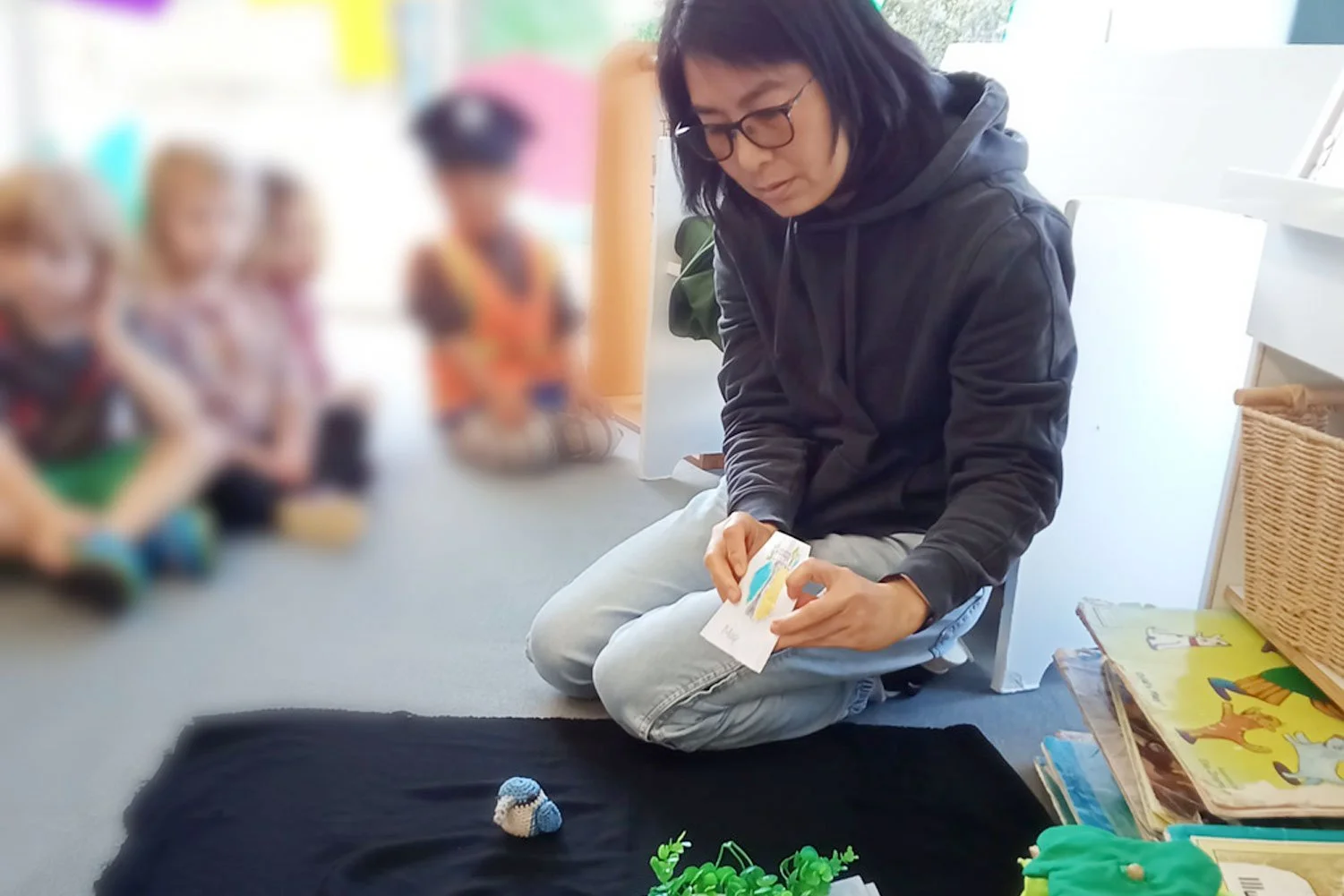
Following our professional development, we put this learning into practice during story-based mat-time activities. The children listened to the story, remembered an instruction and completed a task at the appropriate moment. They also used clues from the story to anticipate what might happen next.
Although it looked like a fun group activity (& it was!), the children were developing a wide range of important skills, including:
Listening and concentration
Auditory memory
Understanding and following instructions
Comprehension
Sequencing
Predicting and anticipating
Conversational turn-taking
Confidence in participating within a group

What does this look like in everyday practice?
These strategies are not limited to planned group experiences. We use them throughout the day during play, conversations, routines and transitions.
For example, when children are building painting or experimenting, we use a strategy of “feeding language” – using descriptive language to explain what we notice. Teachers and parents can get into habits of asking generic, predictable questions such as “What colour is that?” “What are you doing?”
So instead of asking “What are you building?” a teacher might now say “You’re carefully balancing the long wooden block across the two towers.” Or “The red and blue paint have blended together to make purple.”
This introduces descriptive words such as balancing, blended, across and towers while allowing the child to remain focused on their play. The child can listen, process the language and respond if they choose, without feeling pressured.
We also support children to express their needs clearly. If a child gestures towards something or says only one word, we might model a fuller sentence such as “Can you help me open this, please?”, the child is given time to process the language and respond without being rushed or pressured.
Other intentional teaching strategies include giving children plenty of time to find their words, modelling complete sentences, naming objects and areas consistently, encouraging conversational turn-taking and using songs and memory games to make language learning engaging.
Allowing children enough time to find their words is equally important. Some children need several extra seconds to process a questions and organise their response. By pausing and waiting, we communicate that their ideas are valued and worth listening to.
Sharing our news
Sharing news is another valuable strategy we use to develop children’s oral language and communication skills.
Children are supported to organise and communicate their ideas by thinking about questions such as “Who was there? What happened? Why was it important or exciting?”
Speaking to a larger group helps children learn to share information clearly and grow in confidence. The children listening are also active participants. They practice giving the speaker their attention, remembering what has been shared and asking relevant questions to learn more.
This experience supports both expressive language – the ability to communicate thoughts and ideas – and receptive language – the ability to listen, understand and respond to others. It also reinforces the important social skills of taking turns, showing interest and valuing another persons contribution.
Building strong foundations for learning
Strong language and listening skills help children communicate their needs, share their thinking, develop friendships and make sense of the world around them.
They are also important foundations for later literacy and learning at school.
At Uplands Kindergarten, we are continually reflecting on our teaching and developing new ways to support every child to become a capable listener, thoughtful learner and confident communicator.